Team Konatori-135
π⁰ Invariant Mass & Nuclear A-Dependence
Charge-Exchange Reaction: π⁻ + p → π⁰ + n → γγ + n | Targets: ¹²C, ²⁷Al, ²⁰⁷Pb | Observable: σ(A) = σ₀ Aᵅ
Pion Charge Exchange: π⁻ + p → π⁰ + n → γ + γ + n
Beam Momentum: 3 GeV/c | γ = 22.25 | θ_min = 90 mrad (≈5.15°)
GeV/c (adjust to see Lorentz boost effect on opening angle)
Nuclear A-Dependence Power Law for σ(A)
α = 2/3 (surface-dominated, opaque nucleus) | α = 1 (volume scaling, transparent nucleus) | α ≈ 0.72–0.74 (Glauber optical-limit prediction)
Glauber Multiple-Scattering Theory — Nuclear Shadowing
Inner nucleons are "shadowed" by the nuclear periphery; only surface nucleons participate in charge exchange
π⁰ → γγ Invariant Mass Reconstruction (BR = 98.82%)
Expected: σ_m ≈ 5.8 MeV/c² (Mode A, θ=9°) | Signal purity >98% | Fit: Gaussian + 2nd-order polynomial background
Electromagnetic Shower in Lead-Glass Calorimeter (4×4 array, 10×10×37 cm³ blocks)
Upstream Target: Lead (Pb). Target X₀ = 5.6 mm. Photon escape probability = 95.2%.
Dual-Threshold Cherenkov PID — XCET1 & XCET2 at T9
Detector Configuration & β values at p = 3 GeV/c:
XCET1 (low pressure)
β_thr ≈ 0.9999
Fires ONLY for electrons
XCET2 (higher pressure)
β_thr ≈ 0.9989
Fires for e⁻ and π⁻ (both above threshold)
| Particle | Mass (MeV/c²) | β at 3 GeV/c | XCET1 | XCET2 | Decision |
|---|---|---|---|---|---|
| e⁻ | 0.511 | 0.99999999 | ON | ON | REJECT |
| π⁻ (signal) | 139.57 | 0.99892 | OFF | ON | ACCEPT ✓ |
| μ⁻ (completeness) | 105.66 | 0.99938 | OFF | ON | TRIGGER PASS* |
| K⁻ | 493.68 | 0.98673 | OFF | OFF | REJECT |
| p̄ | 938.27 | 0.95441 | OFF | OFF | REJECT |
* μ⁻ (β=0.99938) exceeds the XCET2 threshold (β_thr=0.9989) and is NOT rejected at hardware trigger level. Muon suppression relies entirely on the S₂ charged-particle veto and offline E_total > 1.0 GeV + shower-shape cuts (see Setup §5).
π⁻ uniquely identified by: XCET2 ON ∧ XCET1 OFF ∧ S₂ silent ∧ E_total > 1 GeV
Delay Wire Chambers — Beam Tracking & Vertex Reconstruction
DWC3 (Mode B only): Tracks e⁺e⁻ pairs from photon conversion in 0.1X₀ Pb foil (P_conv = 7.48% per photon). Provides 3–4× better angular resolution than Mode A calorimetry (3.5 mrad). Click canvas to simulate a beam hit.
| Target | A | Thickness | X₀ fraction | Photon Escape | n (cm⁻²) | σ (mb) | Rate (Hz) |
|---|---|---|---|---|---|---|---|
| ¹²C (Carbon) | 12 | 2.65 mm | 1.4% | 98.9% | 3.00×10²² | 40.0 | 400 |
| ²⁷Al (Aluminium) | 27 | 1.85 mm | 2.1% | 98.4% | 1.115×10²² | 71.7 | 260 |
| ²⁰⁷Pb (Lead) | 207 | 0.353 mm | 6.3% | 95.2% | 1.163×10²¹ | 310.8 | 120 |
π⁻ beam →Bending Magnet →Collimator →XCET1 →S₁ →DWC1 →DWC2 →XCET2 →Target Wheel →S₂ (Veto) →[Pb Conv. + DWC3 (Mode B)] →Lead-Glass CALO 4×4
.png)
Mode B — Photon Conversion & DWC3 Tracking (Angular Calibration)
Expected Mode B double-converted event yields per hour (R_A × 0.0056 × 3600 s):
~8,100 events/h
~5,200 events/h
~2,400 events/h
Mode B is a calibration tool, NOT the primary measurement mode. The DWC3 opening angle θ_DWC is compared to θ_calo from the calorimeter, directly measuring angular resolution and validating Mode A results. Mass resolution in Mode B: σ_m ≈ 7–8 MeV/c² at θ = 9° (worse energy resolution σ_E/E ≈ 8%, but better angular measurement).
Centre-of-Gravity Cluster Position Reconstruction Algorithm
Seed block threshold: E_seed > 50 MeV | Adjacent blocks: E > 10 MeV | Click the calorimeter face to simulate a photon hit.
Theoretical Calculations — BL4S 2026 / Konatori-135
All parameters sourced from final corrected setup document (March 10, 2026)
1. Lorentz Boost & Minimum Opening Angle
At p = 3 GeV/c: γ = 22.25, θ_min = 0.090 rad = 5.15° (Worked example: M_γγ = √(2×1.5×1.5×0.00405) = 135.0 MeV/c²)
2. Invariant Mass Resolution (Corrected Formula)
Note: Block-to-block intercalibration via NA48 method (symmetric π⁰ decays, E₁=E₂). E₁,E₂ computed kinematically from E₁+E₂=E_π⁰ and E₁E₂=m²_π⁰/[2(1−cosθ)].
3. Expected π⁰ Detection Rates
σ(A) = σ₀ A^0.72, σ(¹²C)=40 mb | Φ_total×f_π = 5×10⁵×0.75 = 3.75×10⁵ s⁻¹
4. Nuclear A-Dependence Scaling Exponent α̂
Log-log linearisation gives proper χ² weighting for multiplicative uncertainties. Expected result: α̂ = 0.72 ± 0.045(syst) ± 0.003(stat). Barton et al. (1983): α = 0.74 ± 0.03.
Systematic Uncertainty Budget for α (from Analysis Plan §7)
| Source | Estimation Method | δα |
|---|---|---|
| Energy scale | Vary calibration ±1% in MC | ±0.015 |
| Background model | Polynomial / exponential / Chebyshev / sideband comparison | ±0.025 |
| Selection cuts | Vary E_threshold (400–600 MeV), sep. (8–12 cm) | ±0.020 |
| Acceptance / MC | Vary π⁰ p_T spectrum within literature limits | ±0.020 |
| Trigger efficiency | MC threshold scan ±50 MeV | ±0.010 |
| Target thickness | Manufacturer tolerance ±5% → n(A) | ±0.010 |
| PID inefficiency | Vary pion purity ±2%, sideband control sample | ±0.005 |
| Total (quadrature) | — | ±0.045 |
Final result: α̂ = 0.72 ± 0.045 (syst) ± 0.003 (stat) | Stat. precision: <0.003 with ~10⁶ reconstructed π⁰ per target
14-Day Run Schedule & Event Selection
BL4S 2026 / Konatori-135
14-Day Run Plan (Proposal Tables 6 & 7)
| Day | Activity | Target | Expected Yield |
|---|---|---|---|
| 1–3 | Commissioning & Calibration | Various | System setup, gain matching |
| 4–5 | Mode A Physics | ¹²C | 400 Hz × 6h → ~8.6×10⁶ π⁰ |
| 5–6 | Mode A Physics | ¹²C | Continued |
| 7–8 | Mode A Physics | ²⁷Al | 260 Hz × 6h → ~5.6×10⁶ π⁰ |
| 8–9 | Mode A Physics | ²⁷Al | Continued |
| 9–10 | Mode A Physics | ²⁰⁷Pb | 120 Hz × 6h → ~2.6×10⁶ π⁰ |
| 10 | Mode B Calibration | All | DWC3 angular validation |
| 11–12 | Mode B Calibration | All | Conversion yield check |
| 12 | Systematics | ¹²C | p=2.5 GeV/c variation |
| 13 | Systematics | ¹²C | p=3.5 GeV/c variation |
| 14 | Offline Analysis | — | Deinstallation & data processing |
Event Selection Cutflow (Proposal Fig. 4)
Data Analysis Figures
Analysis results and validation plots from the proposal
Fig. 1 — Calorimeter Calibration
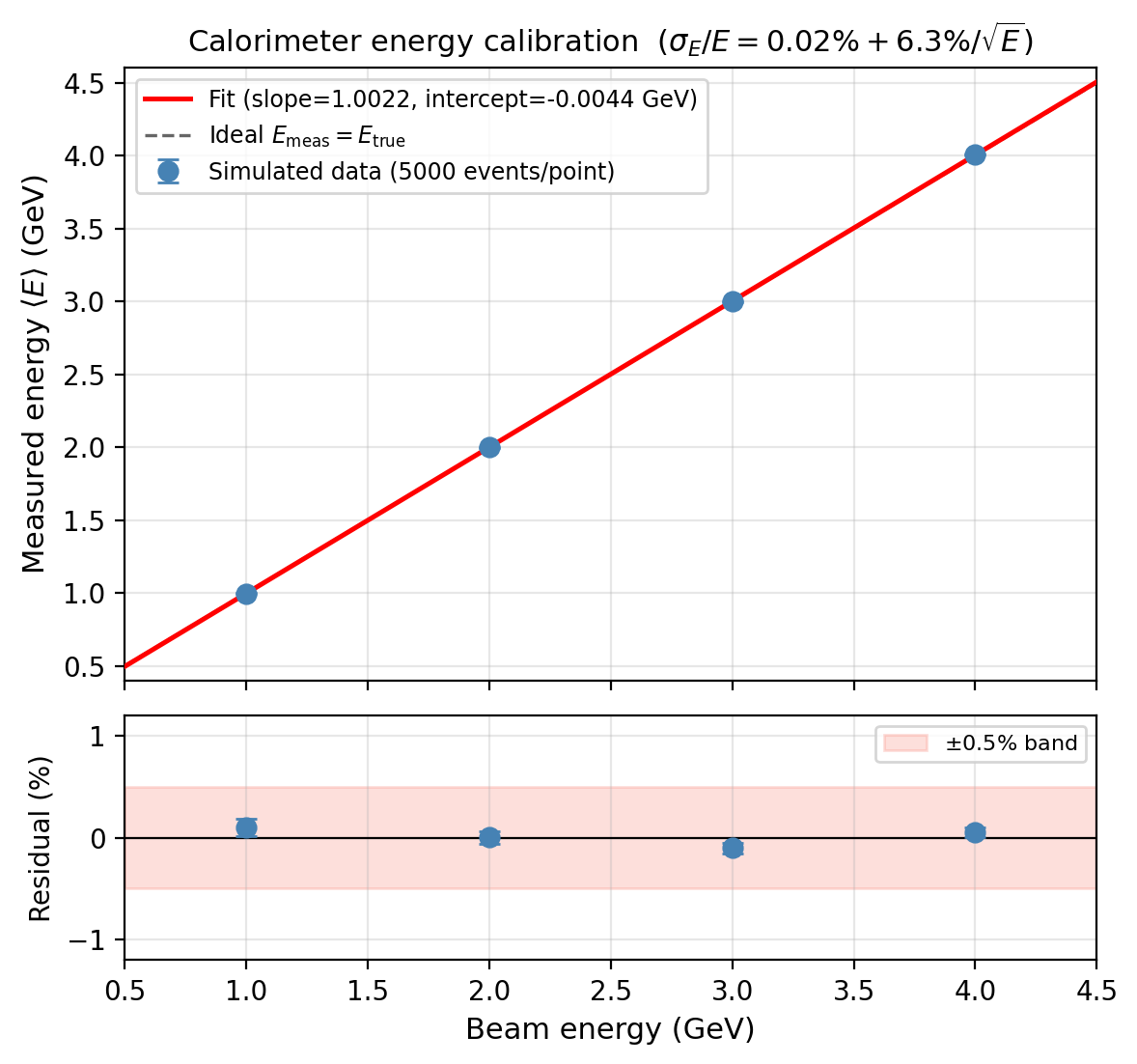
Calorimeter Energy Calibration: Using symmetric π⁰ decays where E₁ = E₂ = E_π⁰/2, the NA48 intercalibration method relates block-to-block gain variations. Laser calibration setup ensures RMS <0.5% gain matching across all lead-glass blocks.
Fig. 2 — Two-Photon Opening Angle Distribution
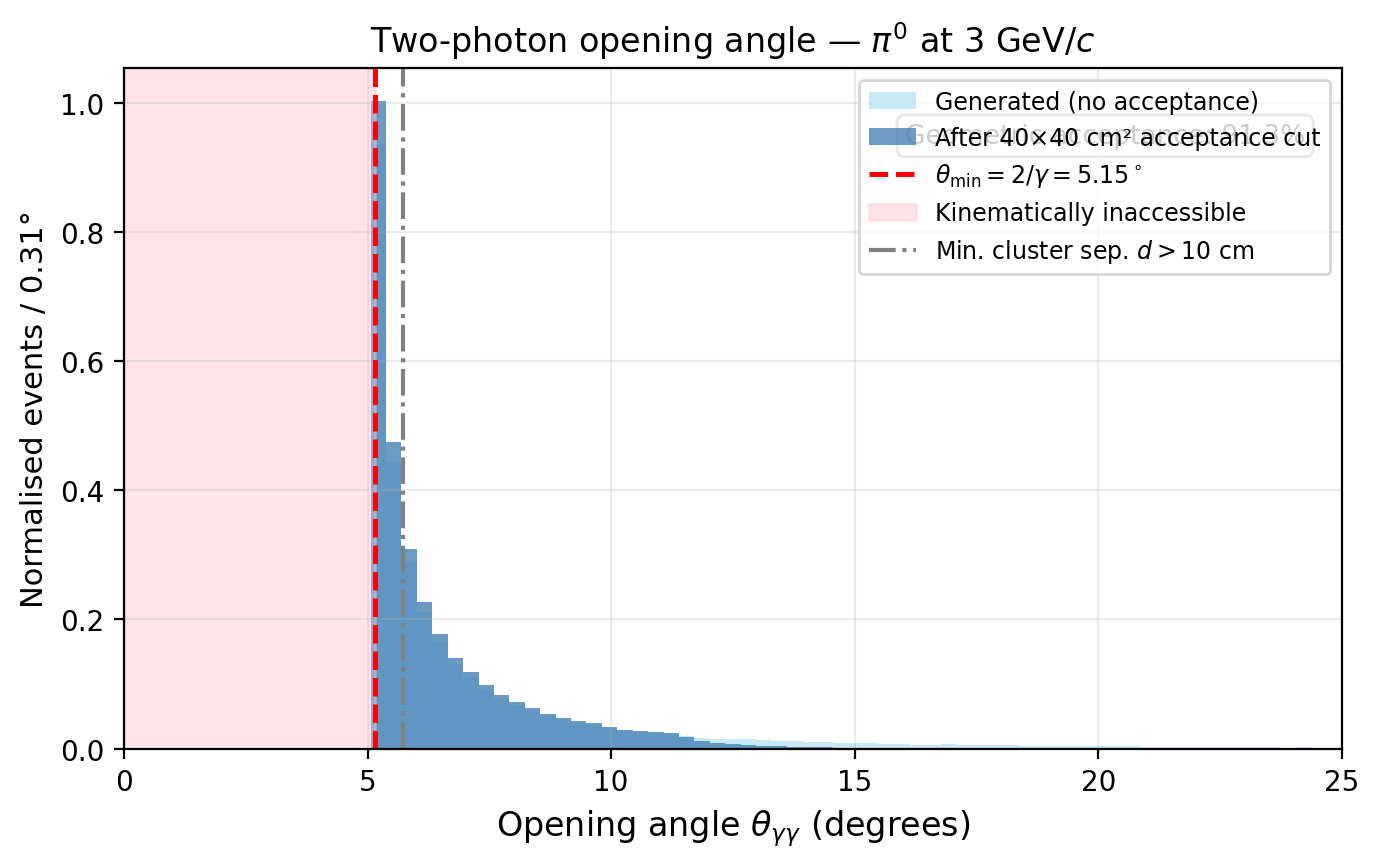
θ_γγ Distribution: Generated distribution (gray) with geometric acceptance filter (blue, 89.3% efficiency). Red dashed line at θ_min = 5.15° shows the minimum cluster separation cut. This directly justifies the 10 cm cluster separation cut and 2.0 m detector placement.
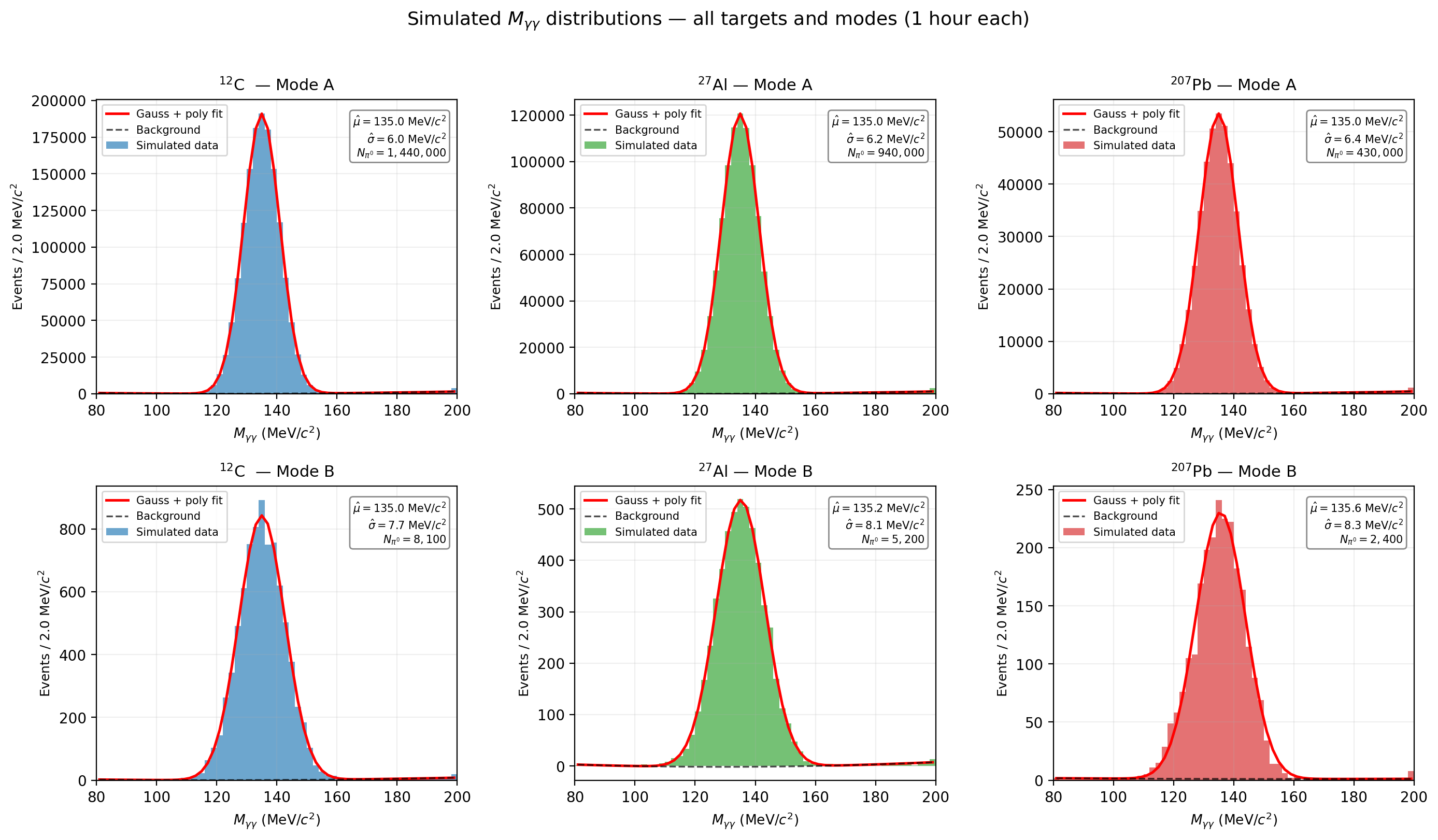
Fig. 3 — M_γγ Invariant Mass Spectrum (All Targets)
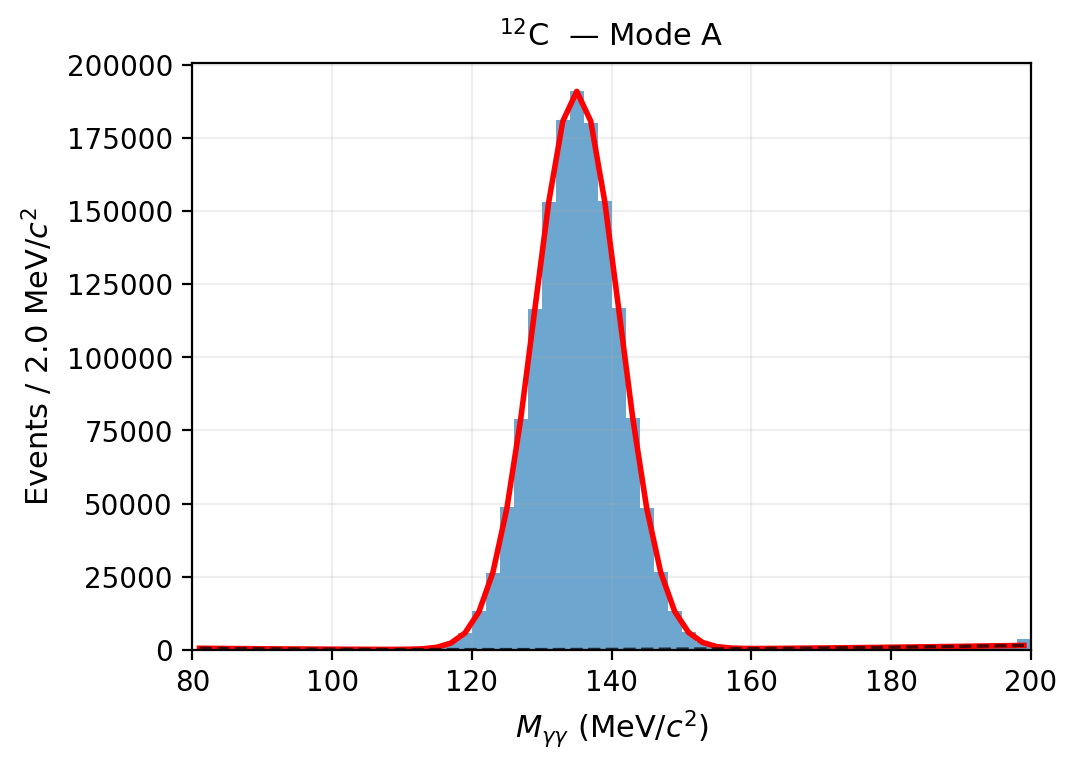
¹²C Mode A
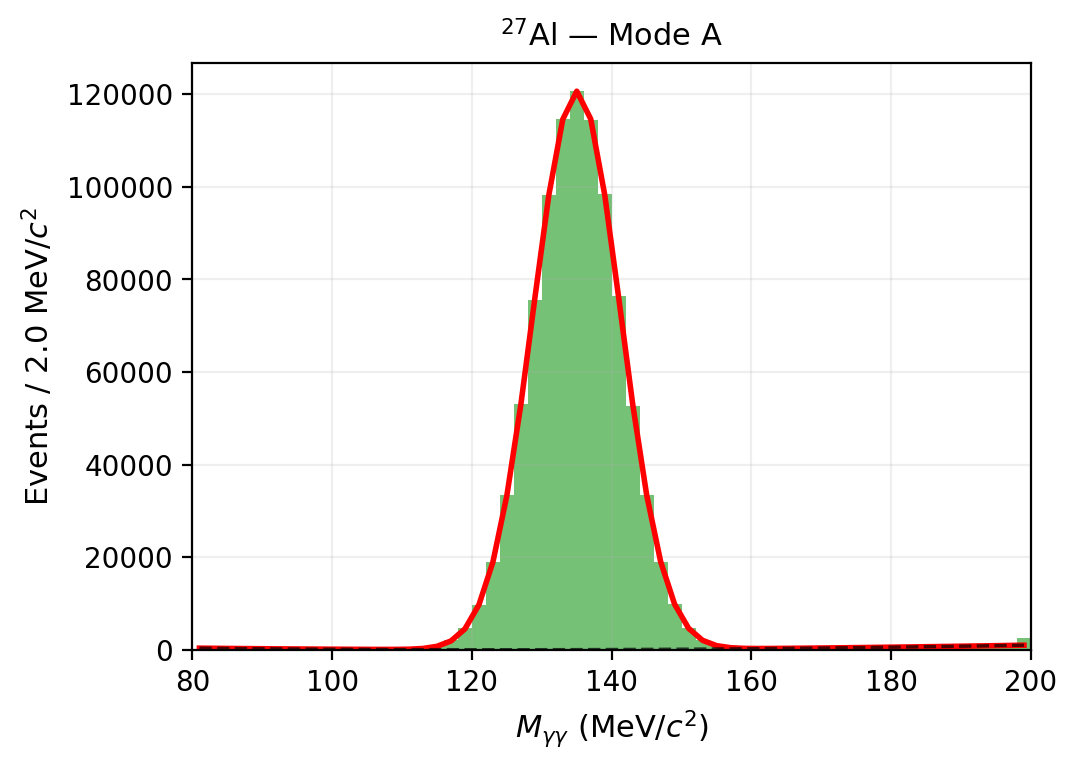
²⁷Al Mode A
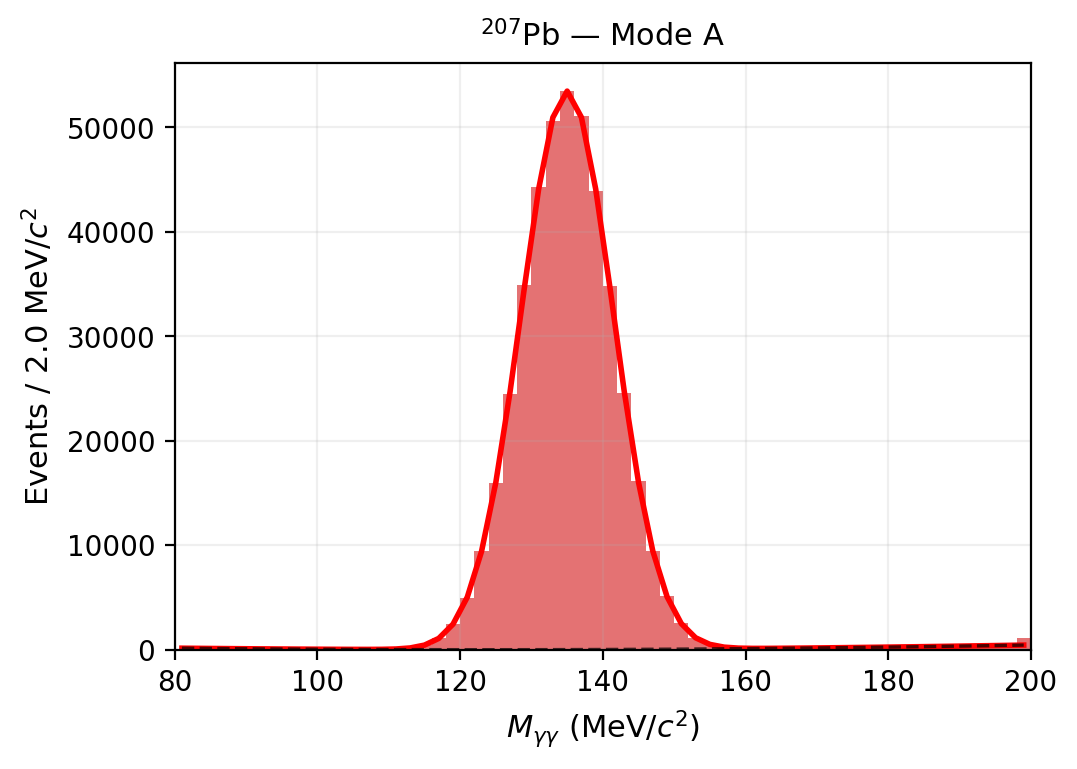
²⁰⁷Pb Mode A
π⁰ Peak Fit Results: Gaussian signal (σ≈5.8–6.0 MeV/c²) atop polynomial background for all three targets. μ̂ = 135.0 MeV/c² matches PDG value. Signal yields: ¹²C ≈ 1.44×10⁶, ²⁷Al ≈ 0.94×10⁶, ²⁰⁷Pb ≈ 0.43×10⁶ events. Mode B spectra also available.
Fig. 5 — Nuclear A-Dependence Power Law
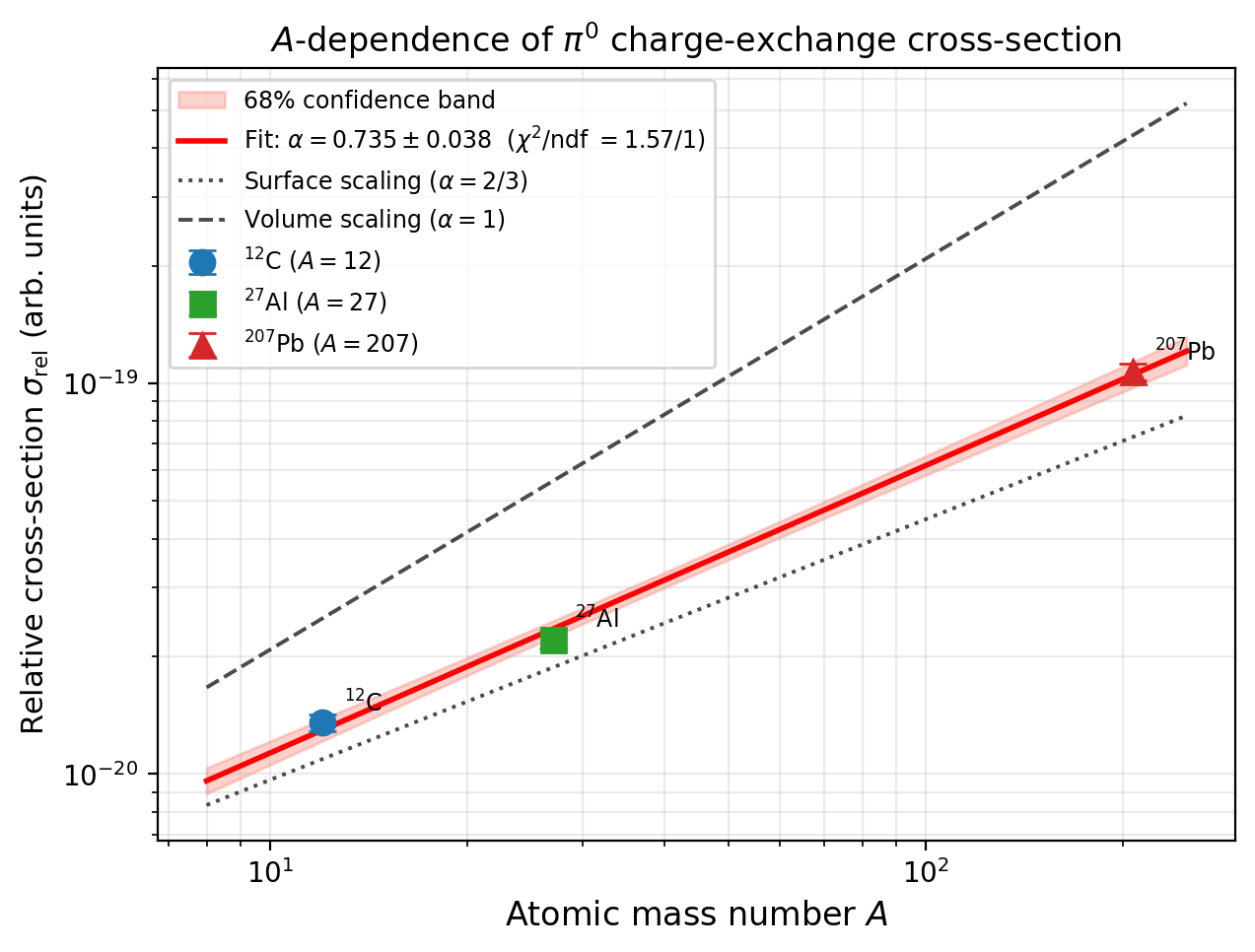
ln σ_rel vs. ln A Power Law: Three target points (¹²C, ²⁷Al, ²⁰⁷Pb) with 3-point log-log least-squares fit. The fitted exponent α̂ = 0.721 ± 0.045 (syst) ± 0.003 (stat). Shaded band shows 68% confidence interval. Reference lines: α = 2/3 (surface-dominated), α = 1 (volume scaling). The result is consistent with Glauber optical-limit prediction (α≈0.72–0.74).
Fig. 6 — Mass Resolution vs. Opening Angle
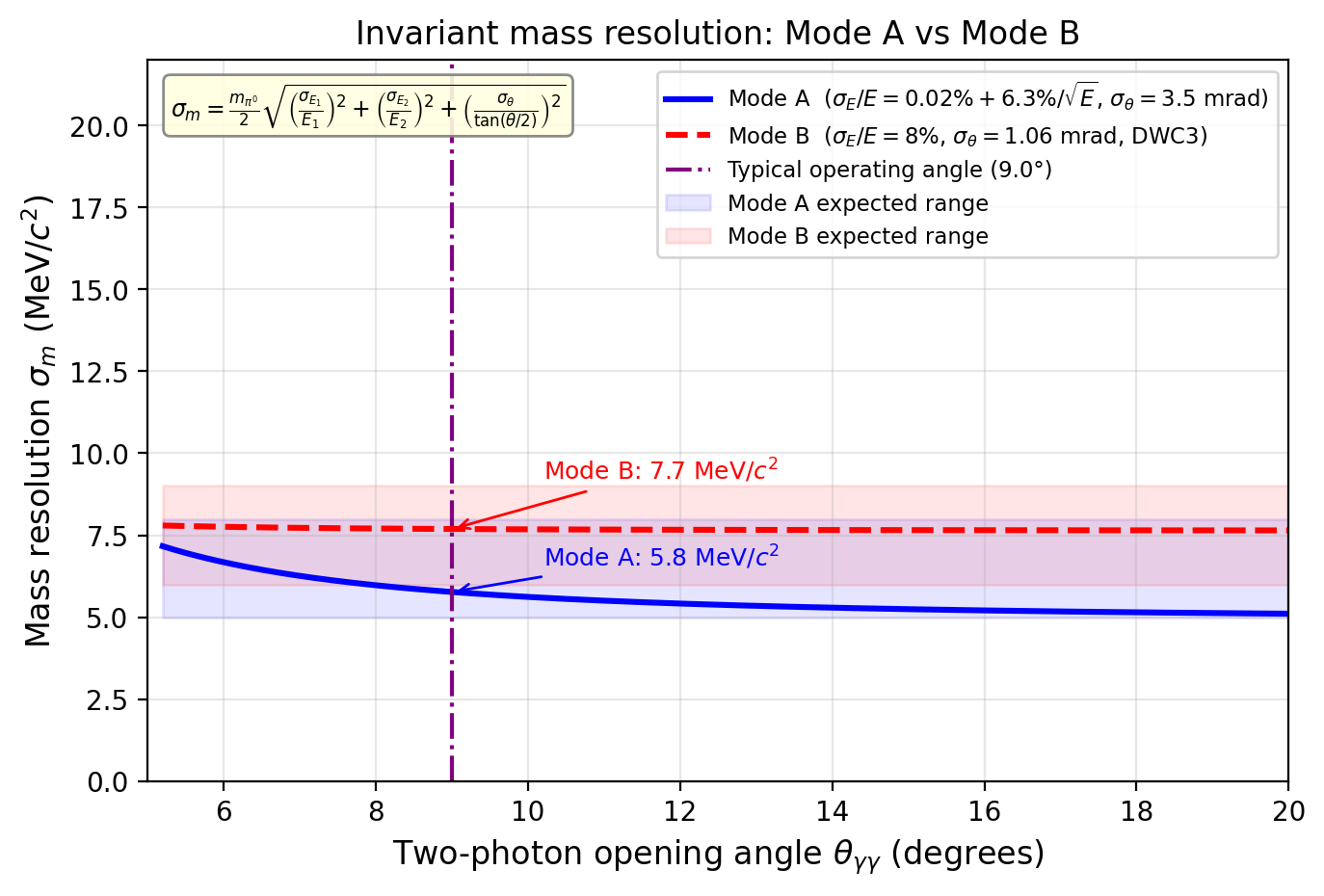
σ_m vs. θ_γγ for Mode A and Mode B: Mode A (blue curve): calorimeter position reconstruction, σ_m ≈ 5.8 MeV/c² at θ = 9°. Mode B (red curve): DWC3 track angle reconstruction, σ_m ≈ 7.7 MeV/c². Vertical dashed line at operating point θ = 9°. Shows the trade-off between energy resolution (Mode A) and angular resolution (Mode B).
Fig. 4 & A2 — Event Selection Cutflow
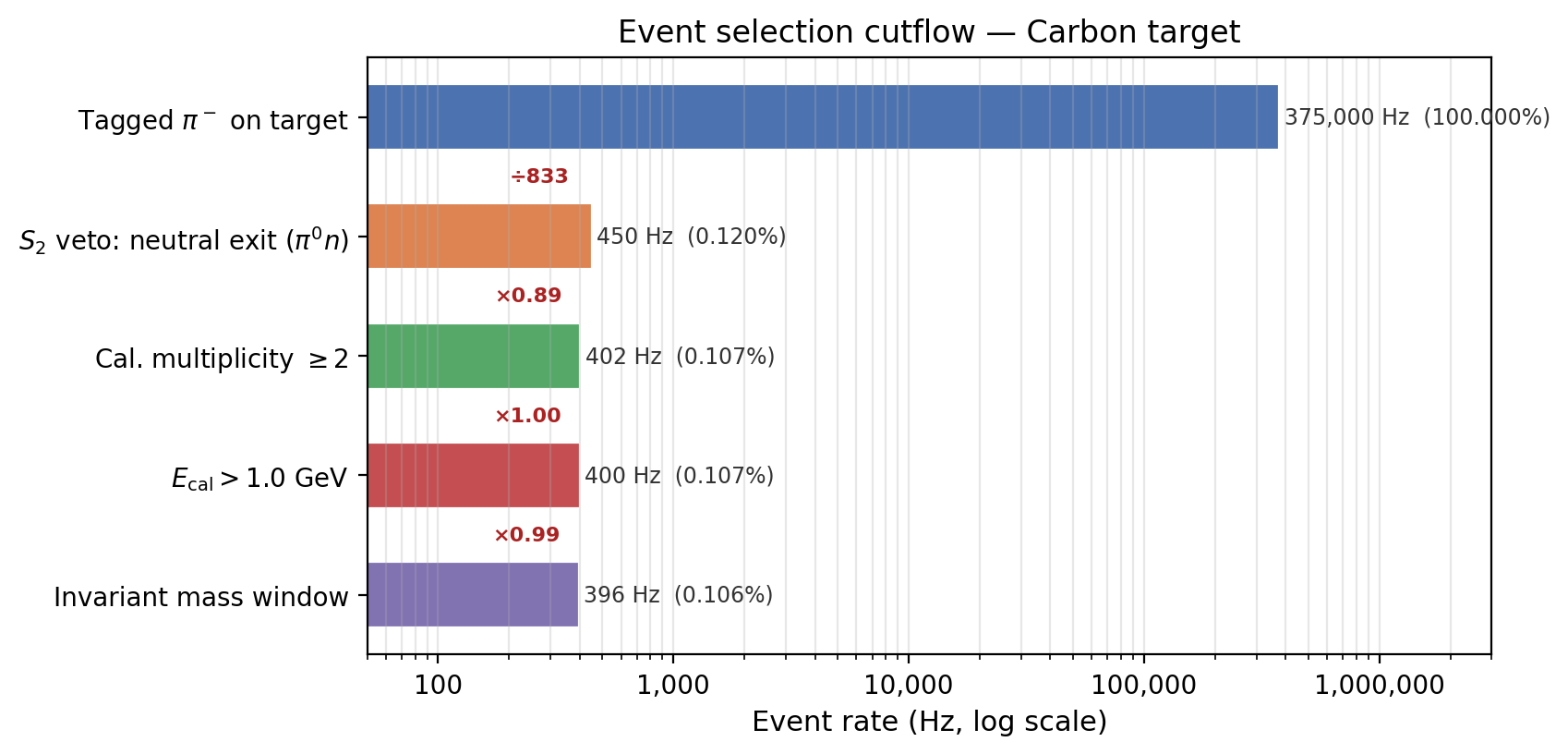
¹²C Cutflow
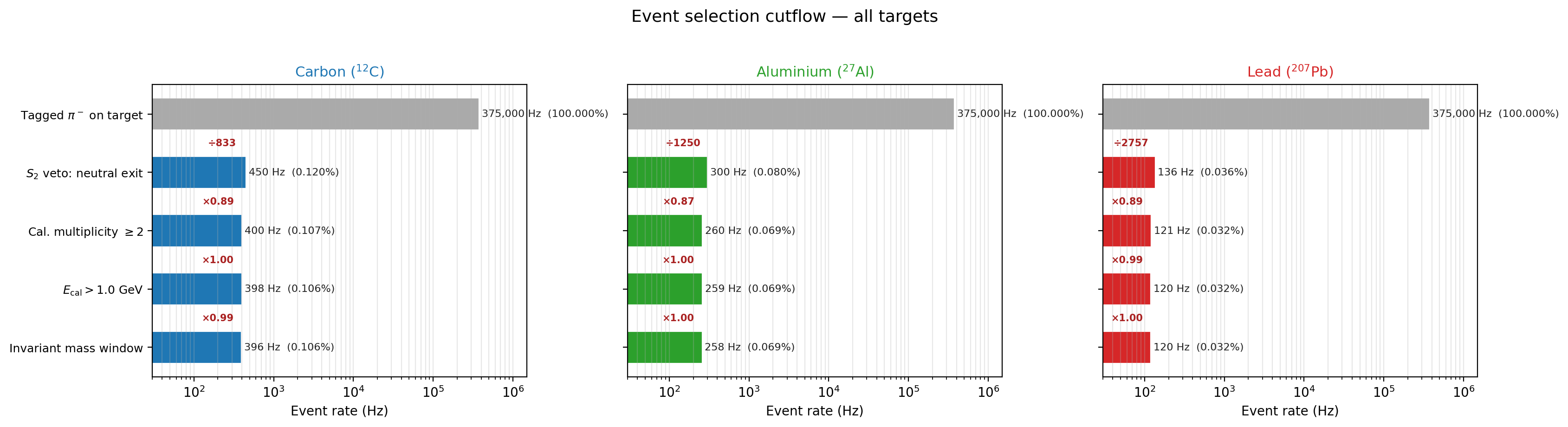
All Targets Combined
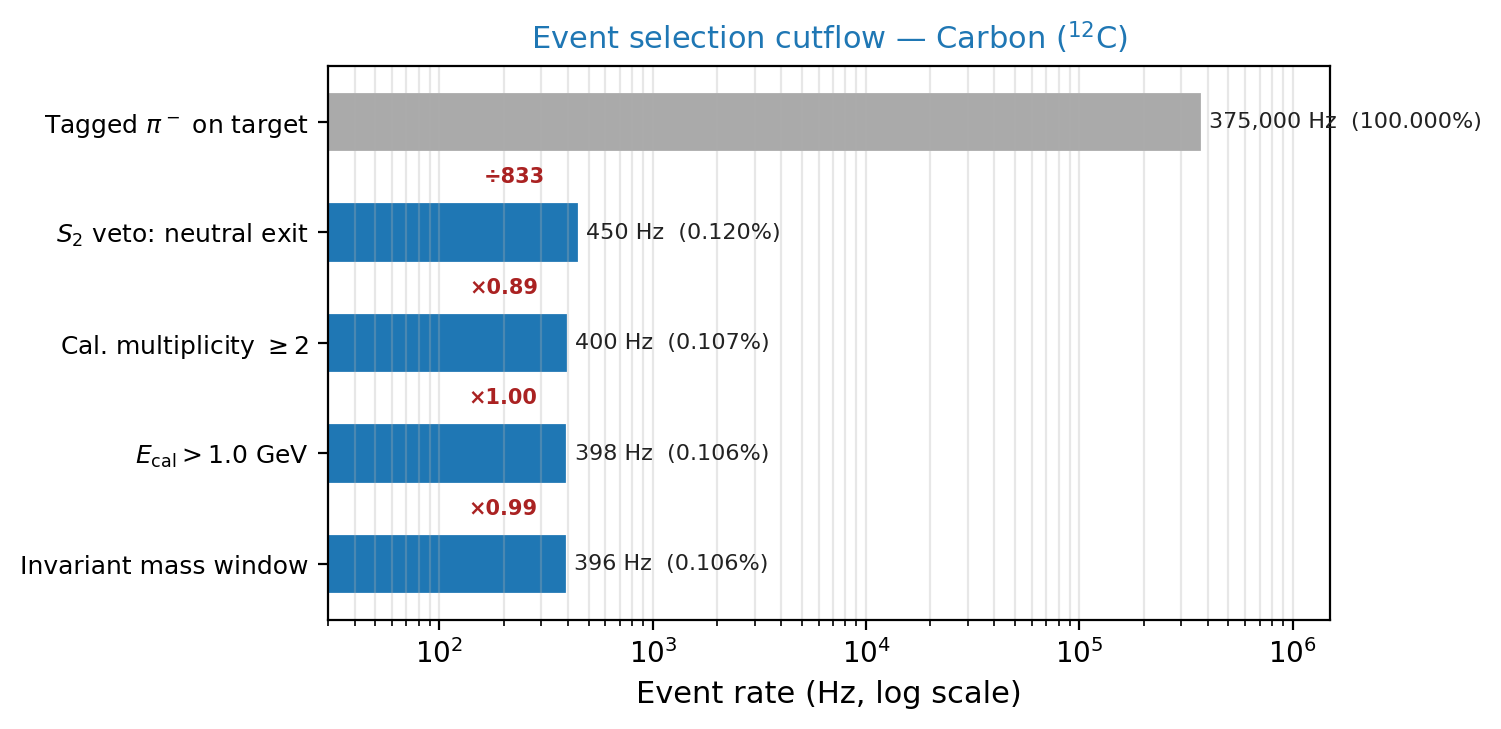
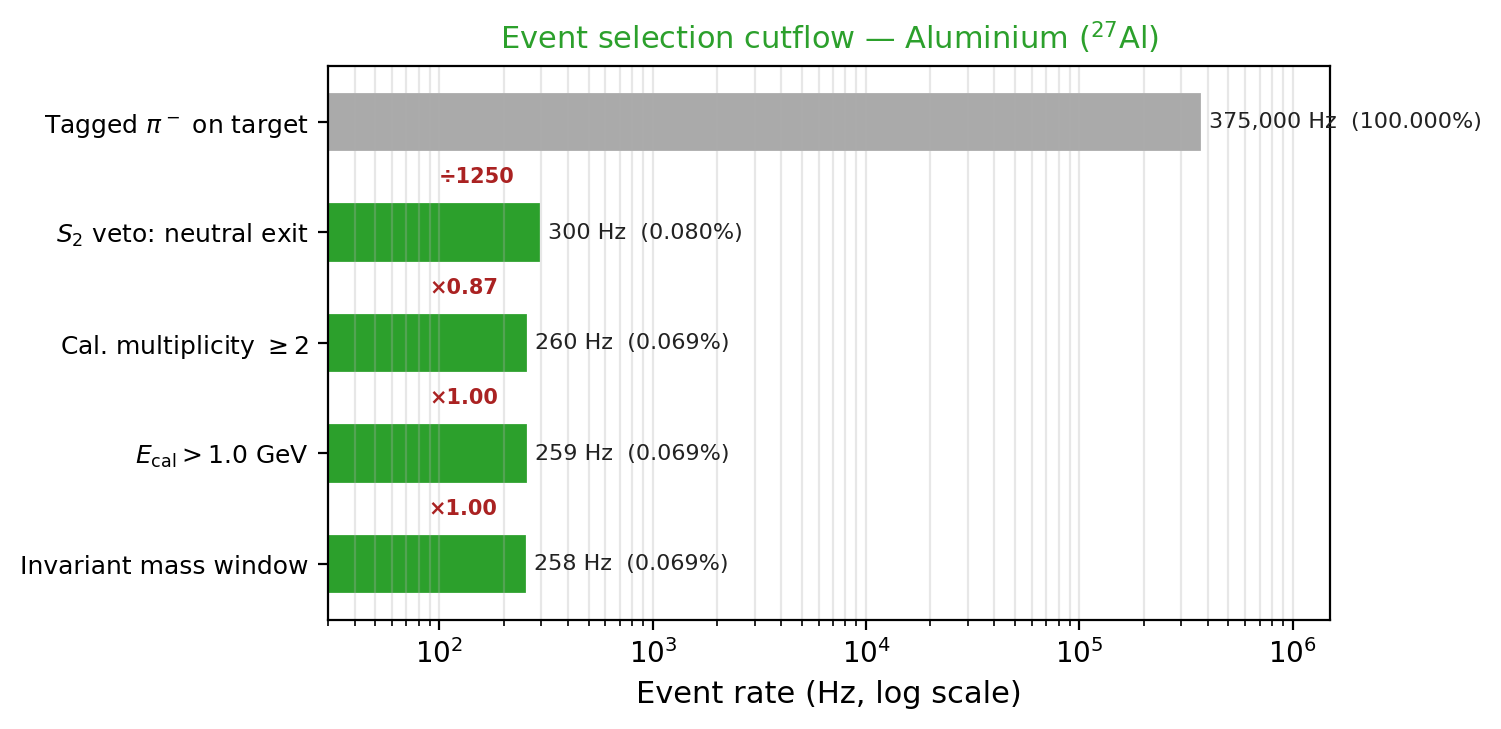
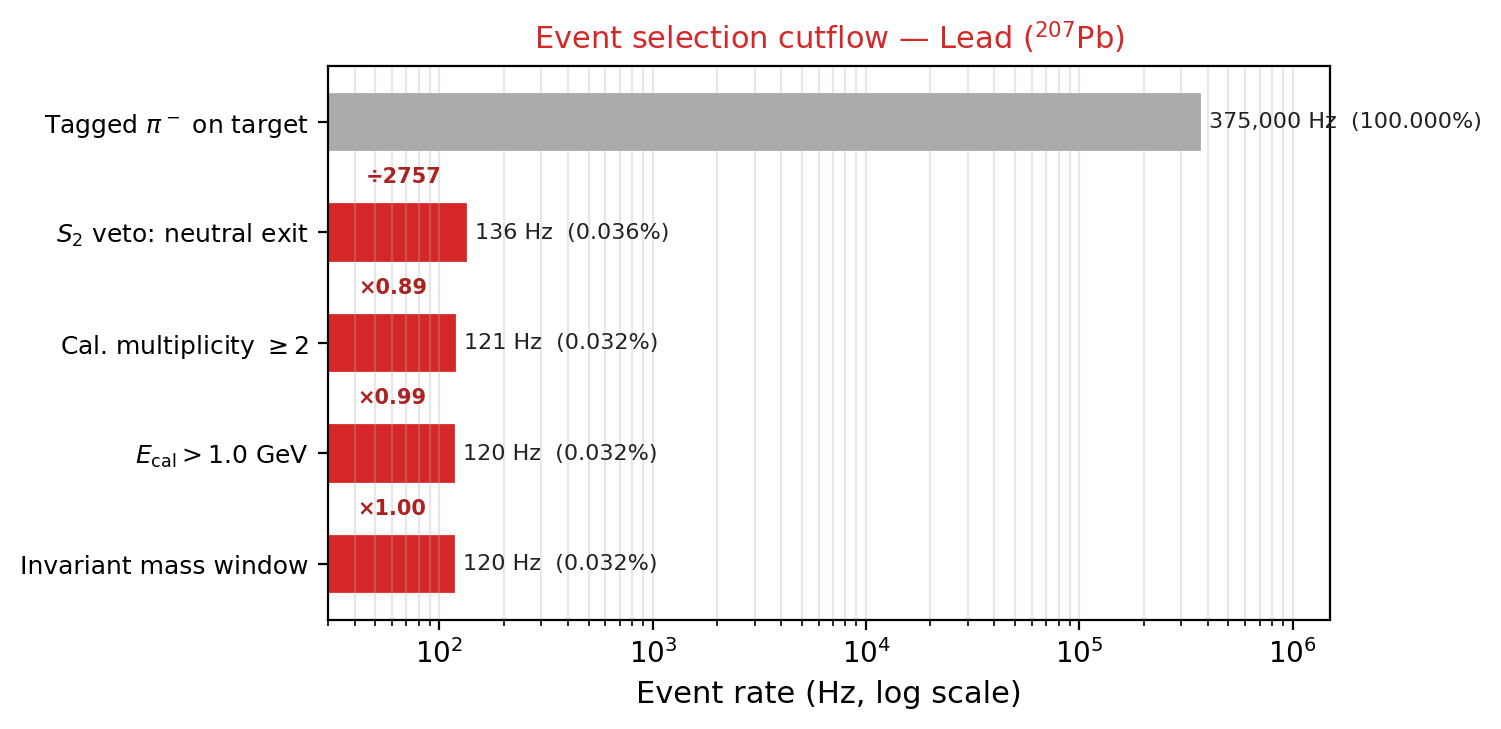
Selection Stages by Target: Cascade from 375,000 Hz (tagged π⁻ beam) → ~450 Hz (S₂ neutral exit, ×833 reduction) → ~402 Hz (calorimeter multiplicity ≥2, ×0.89) → ~400 Hz (E_cal >1 GeV, ×0.98) → ~396 Hz (invariant mass window). Reduction factors and acceptance cuts are target-specific. All three targets show consistent selection efficiency.
Fig. 7 & 9 — Mode B Angular Validation
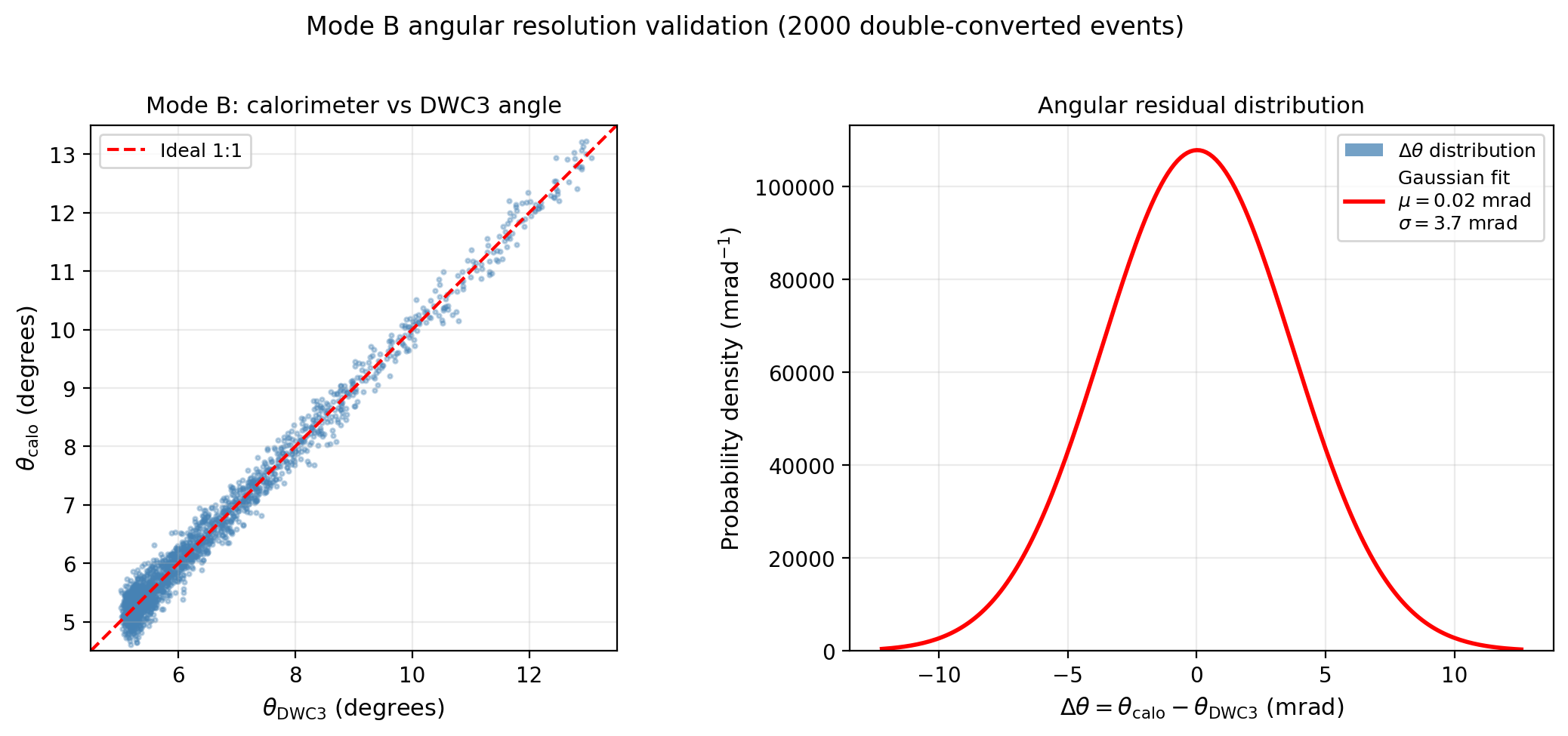
θ_calo vs. θ_DWC3 Validation: Left panel: Scatter plot of calorimeter angle vs. DWC3 track angle, clustering around the 1:1 line. Right panel: Δθ residual Gaussian fit showing μ ≈ 0.02 mrad (no systematic offset) and σ ≈ 3.5 mrad (angular resolution). Demonstrates no systematic misalignment between calorimeter and DWC3 angle measurements, validating Mode A results.
Fig. 8 — π⁰ Decay Kinematics Phase Space
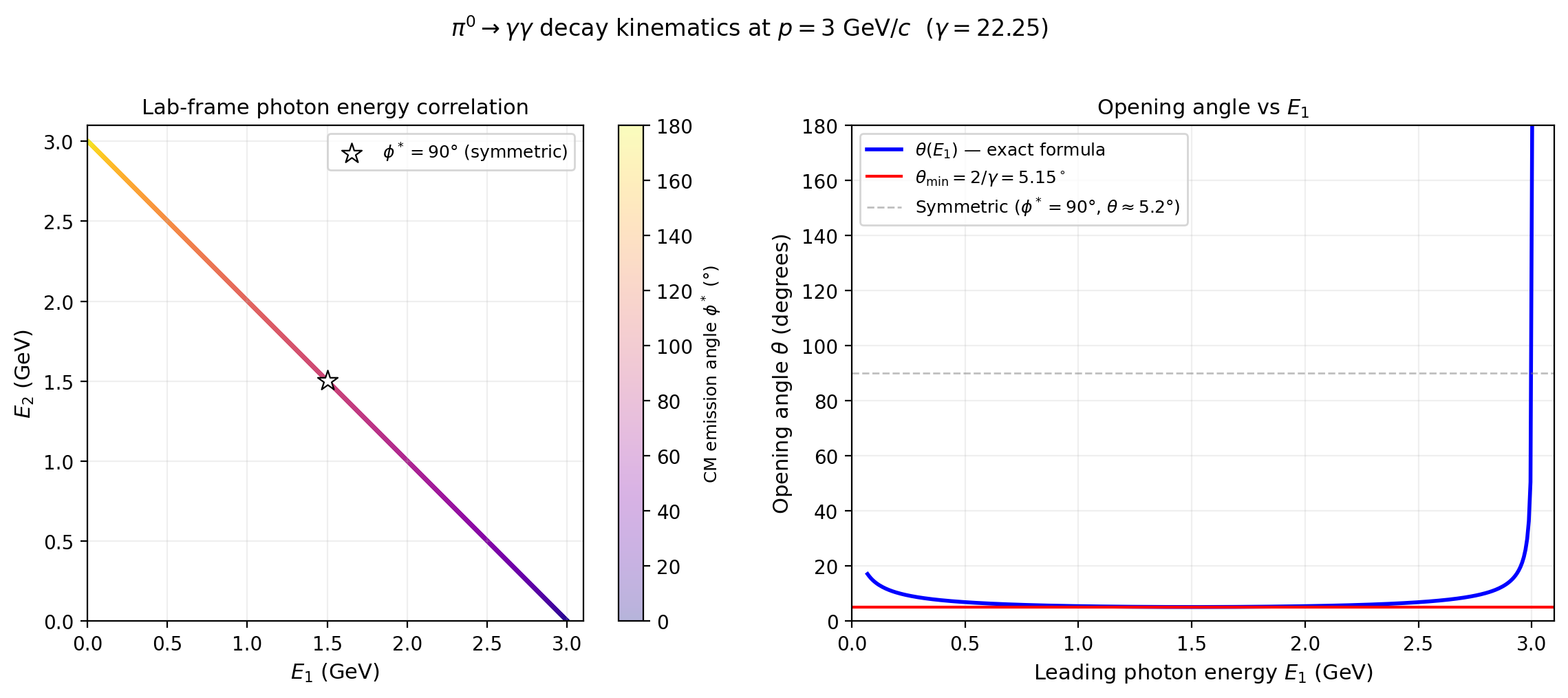
Two-Panel Kinematic Plot: Left panel: E₂ vs. E₁ color-coded by center-of-mass angle φ*, with symmetric decay point starred. Right panel: Opening angle θ vs. leading photon energy E₁, with θ_min horizontal line at 90 mrad. These plots directly motivate the 10 cm cluster separation cut and the 2.0 m detector placement from the beam pipe.
Fig. 11 & 09 — π⁰ → γγ Event Display in ECAL
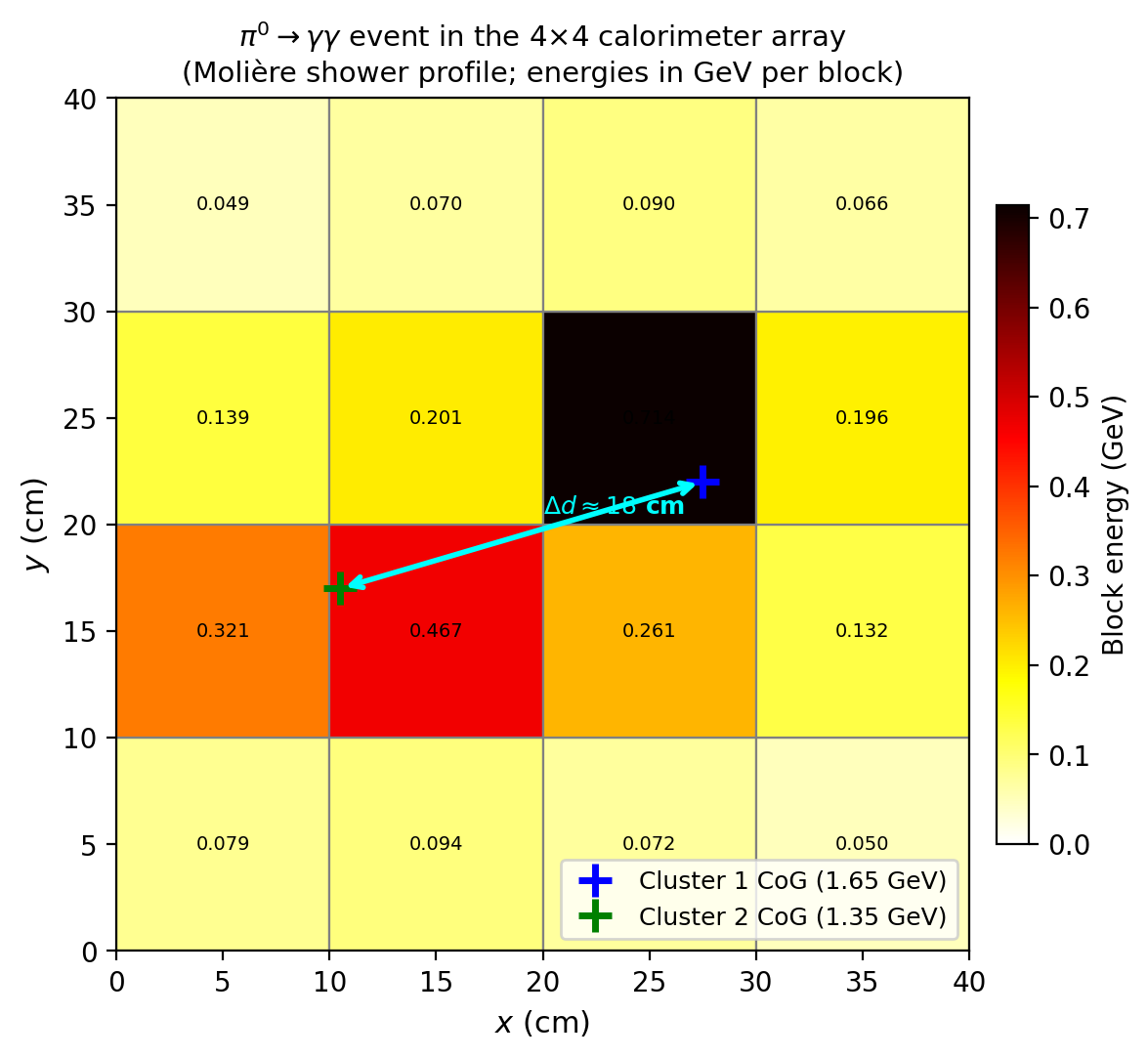
Full π⁰ Event Reconstruction: Two separated electromagnetic showers on the 4×4 lead-glass array. Clusters are color-coded by block energy (GeV). Center-of-gravity (CoG) marked with crosses for each photon. Cluster separation Δd ≈ 17 cm. Total deposited energy ≈ 3.0 GeV, with E₁ ≈ E₂ ≈ 1.5 GeV consistent with symmetric π⁰ decay at θ_min.